
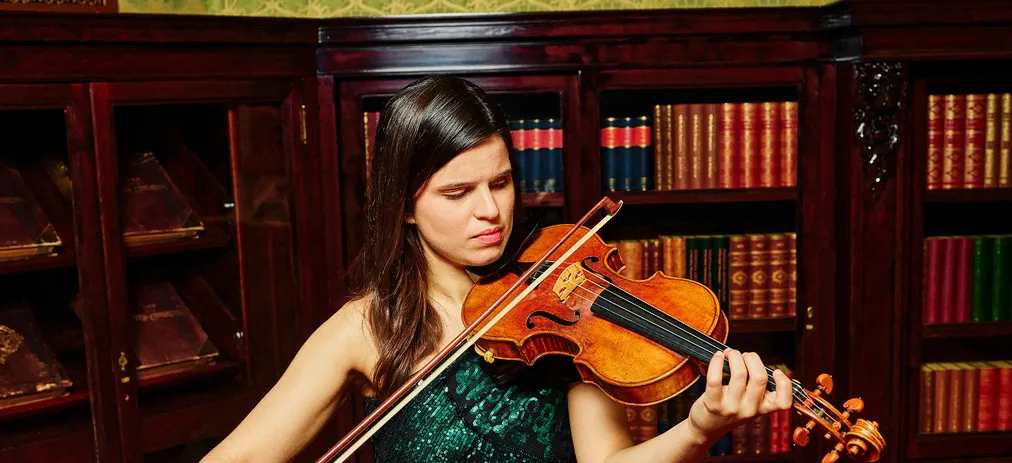
On curating the Artists-in-Residence series
How did you put First Light together? Why these pieces, in this order, on one evening?
I gave Haddon and Tamila the freedom to choose what they wanted to play, so the program grew out of music each of us loves. Tamila opens alone with Ravel’s Jeux d’eau, water and sunlight caught in sound, and the piece that gives the evening its name. For Haddon and me, the Glière felt the most audience-friendly of all the violin and cello music we considered: festive, fun, and spontaneous. And I wanted to close with the Bazzini, for its technical challenges, and because its goblins suit the mood of Halloween.
Was there a work you wanted and couldn’t program?
The Prokofiev First Sonata. In the first movement you can hear raindrops and wind flying through a graveyard, and the second is stormy, completely contrasting. It didn’t fit this time. There’s another piece I’m hoping to bring back before the season is out: the Bach Chaconne.
Why the Chaconne?
It was part of my daily life as a young person, and it traveled with me when I performed abroad. It’s a part of me. Since sixteen, though, it’s been off the stage, and it’s a fundamental part of my repertoire that’s time to bring back. A piece never stops evolving. The Chaconne is the summit of Bach’s writing for violin, the culmination of his dances, and the whole work grows from a single repeating bass line and harmonic pattern.
How do the classics and new works sit together in the series?
The series balances new music with music audiences have loved for generations. First Light is all classics, works written between 1835 and 1909 that Haddon, Tamila, and I have carried with us for years, and we play them with the same immediacy we bring to a score whose ink is still wet. Through the spring, the series pairs the familiar with the new: world premieres by Chen Yi and Elizabeth Younan, and in June, the three Score Call winning works alongside piano trios by Beethoven and Brahms. I also chose Shostakovich’s Second Piano Trio for our May program, beside a brand-new trio.
The two talk to each other. When I come to a new score, I bring everything Beethoven, Brahms, and Shostakovich have taught me. And after living inside a new piece, I come back to the classics with fresh ears. Each makes the other sound new.
You’re bringing Beethoven back this season. How do you prepare music you’ve known for years?
Some of it happens away from the instrument. I’ve made a point of visiting the houses where composers lived, Beethoven’s and Schubert’s among them, and standing in those rooms has brought me closer to the music. Beethoven’s birthplace in Bonn stays with me most. It’s a modest house, with low beams and uneven floors, and then you come upon the viola he played in the court orchestra as a young man, the string quartet instruments Prince Lichnowsky gave him, and his last piano, built by Conrad Graf. Seeing his ear trumpets in the same rooms as his manuscripts, you understand what it cost him to keep writing. I think of that every time I open one of his scores.
How do you choose who plays with you on each program?
For First Light, I wanted a reunion with Haddon and Tamila, my trio partners from last season, and to open the series with that chemistry.
Tamila and I have a sound together that I don’t find with anyone else. We breathe at the same moments, and the violin and piano blend into one voice rather than two. That’s why I wanted her beside me on March 31, an evening that celebrates Chen Yi. Her music means so much to me, and sharing it with Tamila and with our Chicago audience, with Chen Yi there to hear it, is something I’ve looked forward to for a long time.
In January I’m joined by Chelsea Wang, whose playing has a natural grace. She makes the most difficult passages sound effortless, and she listens so closely that every phrase feels shared. We’re still shaping that program together, and I’m excited about where it’s going.
How do you think about the audience when you choose a program?
Chicago audiences love the masters. This is a city that has grown up with Beethoven, Brahms, and Bach, and people come to a concert already knowing these composers, not just having read about them. They understand the style, and the composer is part of the draw. They come curious about how my colleagues and I connect with the work, and about what comes out of all those hours of rehearsal and conversation.
So I think about the whole evening from their seat. I want a program to have contrast and a sense of journey, with something to lean into and something to simply enjoy, like ending First Light with Bazzini’s goblins. And I put new music beside the masters they love, so a familiar piece can open the door to an unfamiliar one. I hope people leave having heard an old favorite in a new way, and having found a new piece they want to hear again.